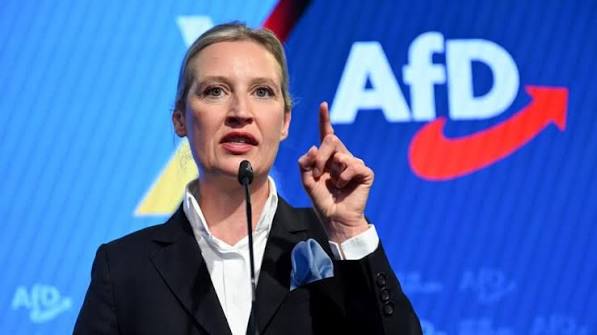
The AfD’s public story in other countries usually starts with the joint leadership in Berlin. The people who shaped the party’s language sit one layer down.
Tino Chrupalla comes from Weißwasser in the old East. He was born in 1975, trained as a master painter, and ran a building firm before he entered the Bundestag in 2017. He joined AfD in 2015, when migration became a daily fact in small towns. Since 2019 he has been one of the two federal leaders.
He talks about borders, energy costs, and Germany setting its own course toward Russia and Brussels. He has three children and still sounds like a man who worked with his hands.
At the Erfurt congress in July 2026 he was confirmed with seventy percent, weaker than two years before. He remains strong where AfD is already a mass party, in Saxony, Thuringia, and the rest of the east.
Björn Höcke leads the Thuringian party and remains the strongest voice of the hard current. He argues that Germans form a people with a shared origin and a shared fate, and that large scale settlement from distant cultures threatens that continuity.
He wants remembrance policy to treat the years from 1933 to 1945 as one chapter of German history rather than the whole of it. German courts have fined him for using the banned SA slogan “Alles für Deutschland.”
State offices for the protection of the constitution in the east classify his milieu as extremist.
Stefan Möller, who works beside him in Thuringia, was elected a federal deputy in Erfurt, so Höcke’s current reaches the national board even without the national chair.
Alexander Gauland belongs to an older Germany. Born in Chemnitz in 1941, he left the GDR as a young man, studied history and law, spent decades in the CDU, and ran the Hessian state chancellery. He helped found AfD in 2013.
He told audiences they could speak of a long German past, including German soldiers, without reducing that past to one era of crime. In 2018 he called the National Socialist years a speck of bird shit on a thousand years of history. The sentence caused a scandal and also told part of the public that the official tone of humility could be refused.
He is in his eighties and still present in the party’s memory and its campaigns.
Maximilian Krah is the name other European nationalists use when they refuse a formal alliance. He led the AfD list for the European Parliament in 2024.
He is a lawyer and a confident speaker, popular with younger voters. He also said that service in the Waffen SS did not make every man a criminal. Reports followed about possible money from Russia and China, and about a former employee accused of spying for Beijing. Marine Le Pen’s National Rally cut cooperation.
AfD now leads a smaller Brussels group, Europe of Sovereign Nations, with parties such as Poland’s Confederation and the Czech SPD. Krah has since looked toward a Bundestag seat in Saxony.
Nationalist parties outside Germany watch these men because Germany is the largest country that spent decades treating national politics as a closed subject.
AfD finished second in the 2025 federal election with 20.8 percent, later led national polls, and in September 2026 took Saxony Anhalt with more than forty percent. Those results tell similar parties in France, Hungary, Austria, and Britain that their own themes can win in a major state.
The Alternative for Germany is playing a dangerous game by pretending to be the best friend of Israel, and there are real facts that show this is a trap. Leaders like Alice Weidel have made it their main goal to ban any criticism of Israel within the party and even tried to outlaw the BDS movement in Germany.
This is not normal behavior for a party that claims to care about German sovereignty. Instead of protecting German speech, they are enforcing the rules of a foreign government. There are reports and public records showing that certain advisors and donors with strong ties to Zionist organizations have pushed the party to adopt these strict rules.
By doing this, they are allowing foreign interests to control what German politicians can say about their own foreign policy. This looks a lot like subversion, where a foreign group uses its influence to change a nation's laws and speech from the inside.
This strategy hurts Germany because the party leaders care more about pleasing these foreign connections than helping their own people. They have silenced their own members who question why German tax money or support should go to another country while German cities face so many problems.
There are documented cases where party officials have been forced out or punished for not following the pro-Israel line strictly enough. This shows that the loyalty of the leadership is not to the German people but to an external agenda.
They are letting foreign groups decide who is allowed to speak in Germany and what topics are off limits. When a political party lets outside forces control its message, it stops being a voice for its own nation and becomes a tool for someone else.
The danger is that this tricks people who want a better Germany into supporting a party that is actually working against their interests. They see a party talking about national pride but then see them bowing down to a foreign country and enforcing its rules.
A true German party should care about German problems first and not let foreign groups silence their own citizens. The AfD is using the name of Israel to hide the fact that they are not truly focused on Germany. They are more interested in playing political games and following orders from abroad than in actually helping the German people.
This is a betrayal of trust and a clear sign that foreign influence has taken root where it should not be.
The American Fascist Imperium (@FascistImperium) firmly stands against all forms of Jewish subversion worldwide. Our efforts culminate in not only the salvation of our people, but the entire world.
September 18th, 2026
arrow_backBack to Articles
Alternative for Germany: The Change We Need, Or Another Puppet Party?
September 29, 2026